Direct answer: OCR answers “Which characters may be on this page?” P&ID understanding must answer “Which engineering objects and relationships are asserted, under what conditions, and where is the evidence?” The output is not text. It is a reviewable set of engineering obligations with provenance and explicit uncertainty.
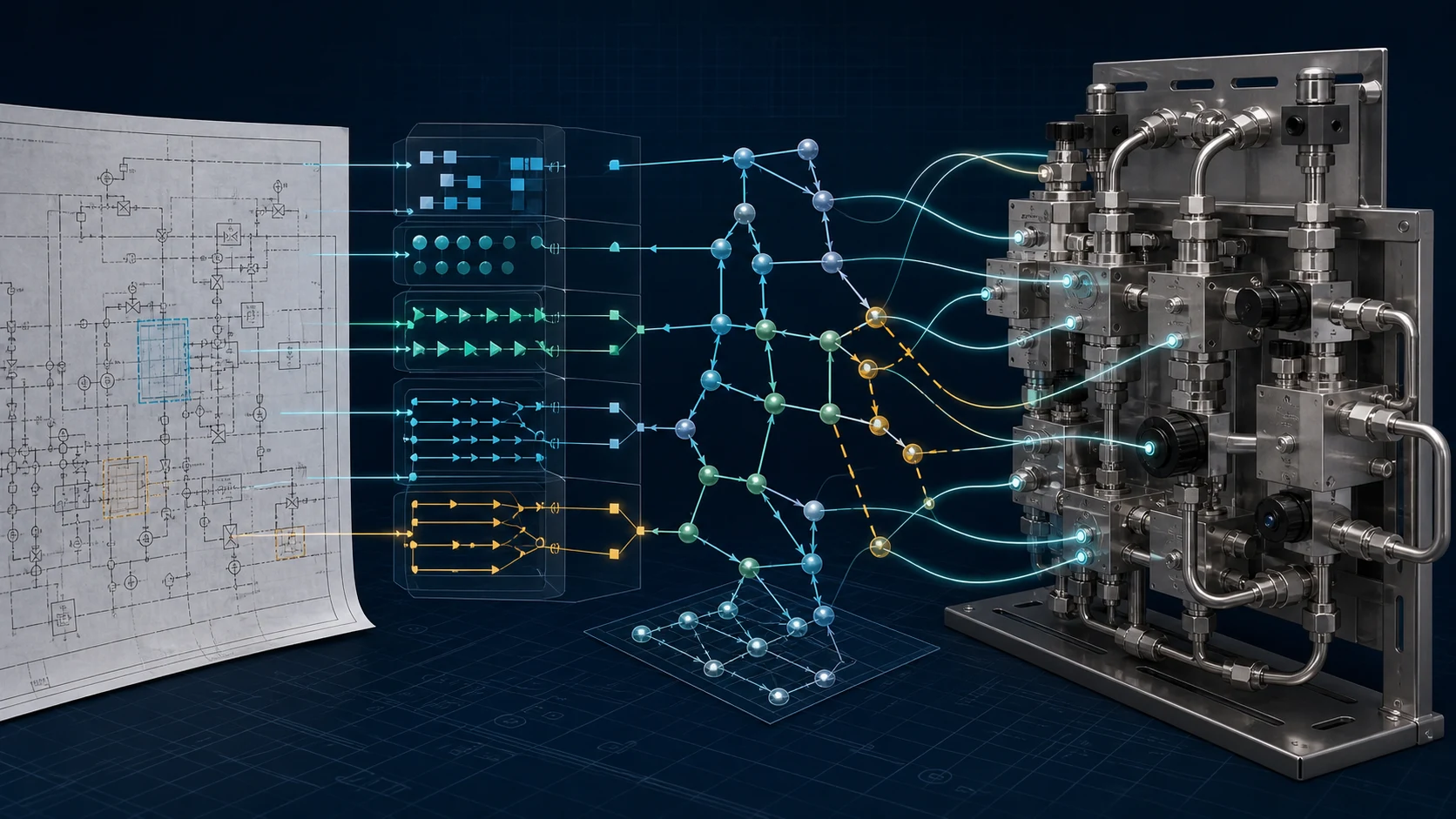
A P&ID carries several layers at once
Text, symbols and linework share the same sheet, but they do not have the same meaning. A tag can identify an instrument. A line can represent a material path, a signal or a graphical leader. A valve symbol affects connectivity, and a continuation reference can connect two different pages. Direction and operating state may be explicit, implied by convention or genuinely unresolved.
Flattening those layers into words loses the relationships that equipment design needs. Treating every crossing as a connection invents relationships that may not exist.
Five transformations separate OCR from engineering understanding
- Observation: locate text, symbols, line segments, arrows, crossings, page connectors and revision evidence.
- Identity: bind observations to equipment, piping and instrumentation objects while retaining alternatives.
- Topology: reconstruct ports, junctions, branches and cross-page connectivity rather than merely tracing pixels.
- State: represent direction, bypasses, valve or operating conditions and the scope in which an edge is active.
- Obligation: declare which relationships must later be realized physically and which remain blocked for review.
The industry already distinguishes graphics from conceptual information
DEXPI publishes vendor-neutral models for exchanging process-industry engineering information. Its P&ID model separates a conceptual model from diagram representation and covers packages such as equipment, piping, instrumentation, graphics and physical quantities. DEXPI also describes the exchange problem in terms of graphics, topology and engineering attributes—not text alone.
IEC 62424 likewise addresses representation of process-control engineering requests in P&IDs and exchange between P&ID and PCE tools. These standards do not validate MST’s recognition performance. They demonstrate why a P&ID contains structured engineering information that OCR alone cannot recover.
Why “AI saw the symbol” is not sufficient evidence
A production-oriented system should keep the page, bounding region, source revision, candidate interpretation, confidence and any conflicting observations. When a later graph edge says that V101 feeds MFC201 under a declared condition, an engineer must be able to return to the source marks that support that statement.
W3C PROV-DM is domain-independent, but its distinction among entities, activities, agents and derivations is useful here: the graph should not appear without a record of what document entity was used, what recognition/formalization activity occurred and who approved the result.
The category is Engineering Intelligence. The compiler is one mechanism inside it.
The important step is not replacing a human drafter with a chatbot. An engineering compiler turns ambiguous engineering communication into typed, testable obligations and preserves them through part selection, 3D physical layout, native CAD execution and reverse verification. The wider Engineering Intelligence system also maintains world state, plans work, orchestrates governed tools and returns evidence under human authority.
Proof-carrying engineering is the system’s validation contract—not a competing product category. A plausible interpretation is not accepted merely because it reads well. It must carry source evidence, survive deterministic checks and stop when the required meaning cannot be proven.
What would constitute public proof
A credible demonstration should show a fresh P&ID package, the source-grounded observations, the resulting directed/conditional graph, an ambiguity that is not guessed, and the exact obligations passed downstream. A benchmark should publish scope, fixture count, metrics, error classes and limitations. A marketing animation cannot replace that evidence.
Explore the Engineering Intelligence system, inspect its implemented Mechanical Assembly AI and separate run-specific evidence boundary, or read the technical mechanism in How a P&ID PDF Becomes a Directed, Conditional Engineering Graph.
Practice reading a P&ID
Use the P&ID reading tutorial to trace symbols, tags and connections into a reviewable worksheet. Then connect component identity to the BOM and configuration exercise.
References
- DEXPI Specifications — open vendor-neutral process-industry engineering data models. Accessed 2026-08-07.
- DEXPI P&ID Specification 1.4 — introduction and exchange objectives. Accessed 2026-08-07.
- IEC 62424:2016 — P&ID/PCE representation and exchange. Accessed 2026-08-07.
- W3C Recommendation — PROV-DM. Accessed 2026-08-07.
Limit: this is a category and architecture explanation. It does not report arbitrary-PDF recognition accuracy or imply that DEXPI, IEC, ISO or W3C endorses MST.
MST Engineering Intelligence. “P&ID Understanding Is Not OCR: From Pixels to Engineering Obligations.” MST Engineering Intelligence. Updated 2026-09-16. https://mst-us.ai/pid-understanding-is-not-ocr/
CUSTOMERS · PARTNERS · INVESTORS
Talk to the engineering team.
Bring a non-confidential P&ID question, pilot boundary or technical diligence request. Protected engineering material is exchanged only after identity, NDA and scope review.
Operated by MOORE SOLUTION TECHNOLOGY PTE. LTD. · Singapore UEN 202315239E