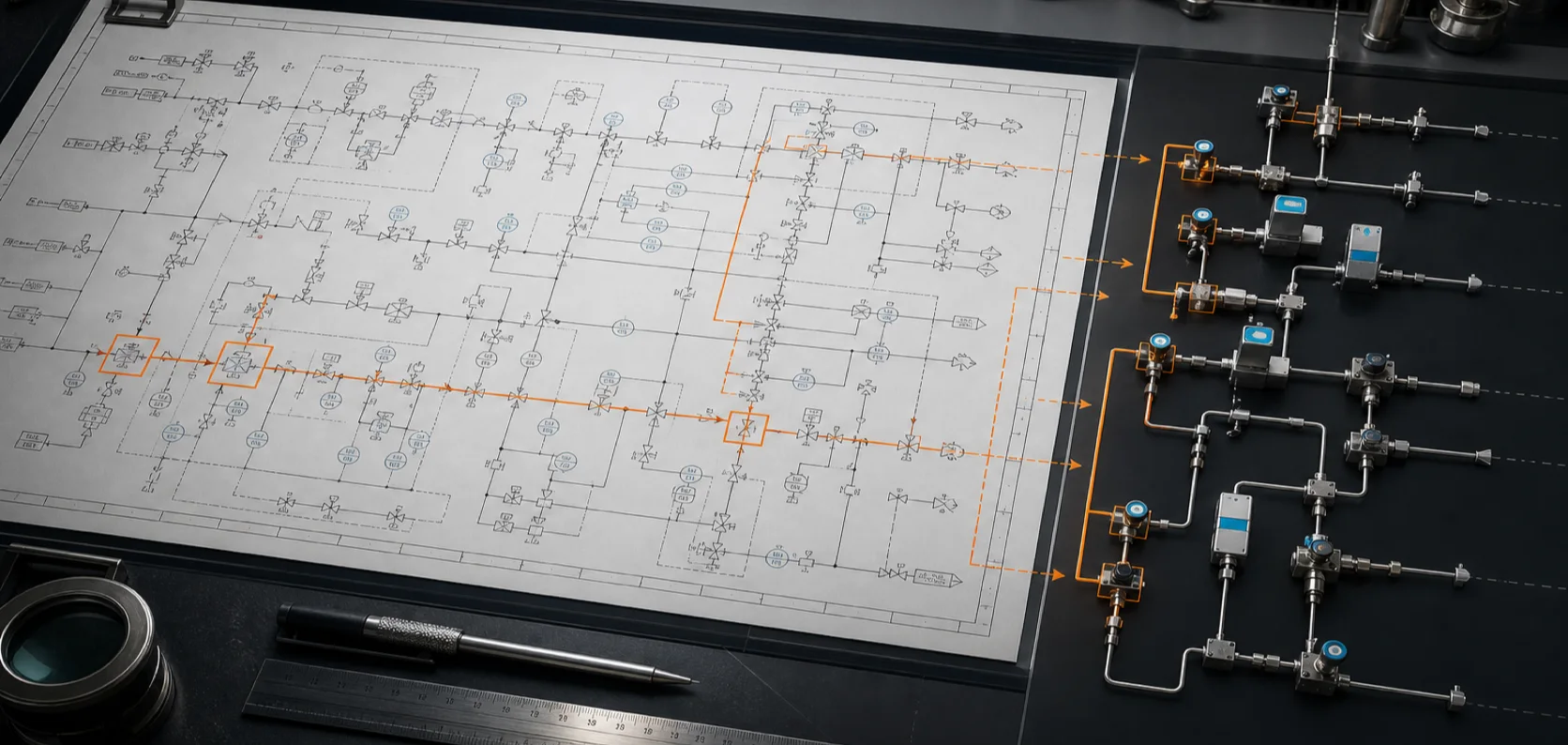
A P&ID PDF becomes an evidence-bearing engineering graph.
Recognition is only the first boundary. The product preserves where each observation came from while recovering identity, direction, conditional state and topology.
01 / OBSERVATION CONTRACT
OCR can copy marks. Engineering understanding must preserve meaning.
A symbol name without location, a line without direction or a connection without operating condition is not enough to drive physical design. MST records observations before it permits inference.
Source-grounded semantics
A graph node is not trustworthy until it can point home.
The typed graph retains the source pointer and the reasoning boundary used to create each node and edge.
02 / DIRECTED & CONDITIONAL GRAPH
Connectivity alone is not process intent.
The graph preserves flow direction, equipment and instrument roles, branching, bypass logic, cross-page continuation and declared operating conditions. It does not flatten the drawing into an undirected network.
Node contractIdentity, type, ports, state, source pointer and qualification status.
Edge contractFrom/to port, direction, connection class, condition and source linework.
Continuation contractCross-page references stay unresolved until both endpoints can be evidenced.
Ambiguity contractCompeting identities or connections are ranked for review, never silently promoted.
03 / CURRENT BOUNDARY
What this page proves—and what it does not claim.
In scopeApproved semiconductor process-equipment P&ID fixtures, typed symbol vocabularies and project-reviewed rules.
Not claimedUniversal recognition of arbitrary drawing conventions without qualification.
OutputEvidence-bearing observations plus directed and conditional engineering topology.
Human authorityEngineers approve vocabulary, unresolved ambiguity and release boundaries.
NEXT CONTRACT
Open 3D Physical Layout Turn process intent into a physical XYZ realization.
ANSWER-READY NEXT STEPS