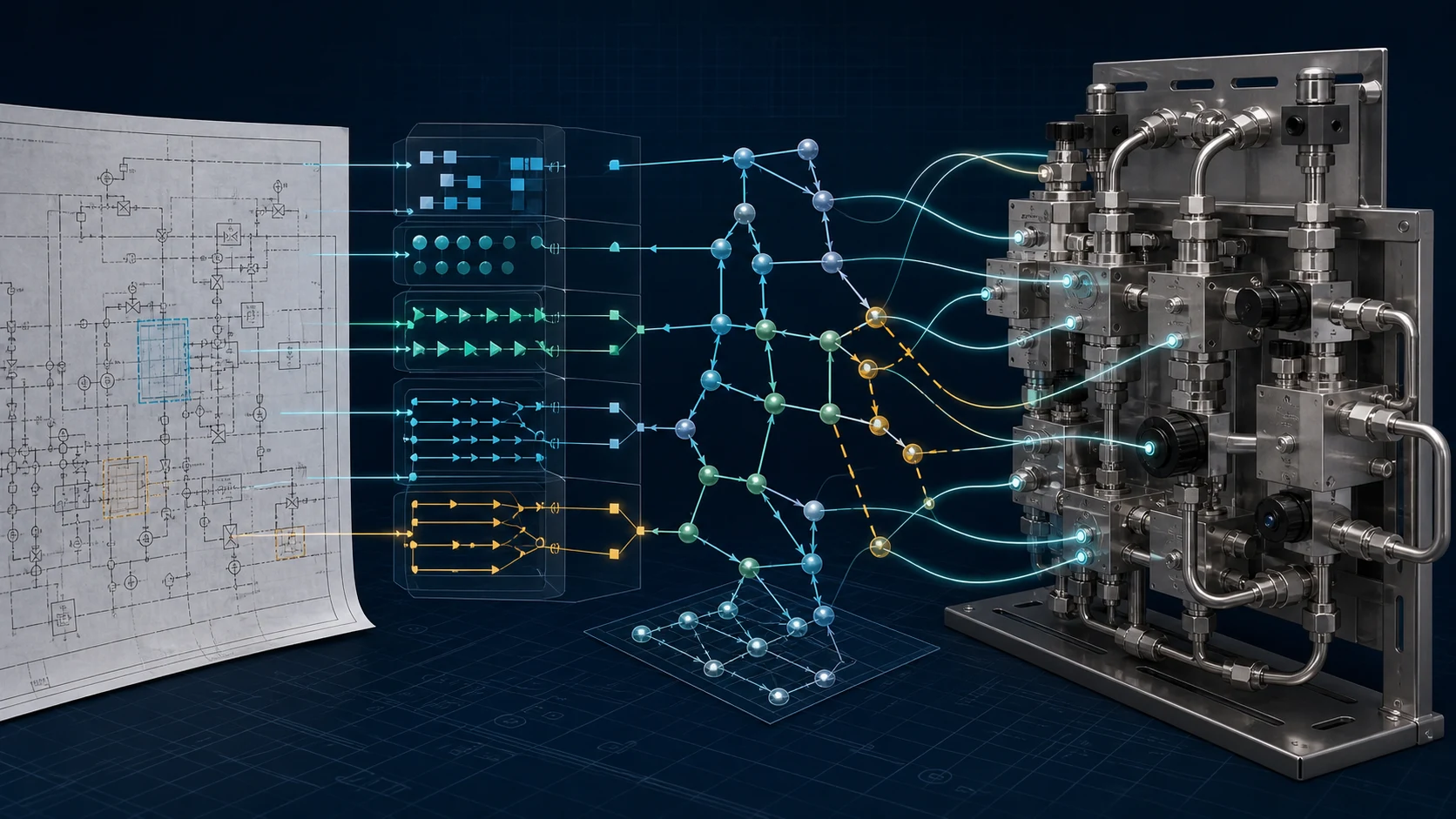
Direct answer: the conversion should be staged, typed and fail-closed. First record immutable source evidence. Then produce observation candidates, bind engineering identities, reconstruct connectivity, assign direction and conditions, validate graph consistency and emit only supported design obligations. Every edge must retain a path back to the PDF.
1. Freeze the source package
Record document checksum, revision, sheet number, page transform and any vector/raster layers. Do not normalize away the original coordinate system. Evidence localization later depends on a stable mapping from an observation to its exact source region.
2. Build observations before objects
Detect text regions, symbol candidates, line segments, arrows, junctions, crossings, page connectors and revision marks. An observation is not yet an engineering fact. It carries a candidate type, geometry, source location, method/version and uncertainty.
3. Resolve identity without erasing alternatives
Bind tags and nearby symbols into candidate equipment, valve, instrument, port or line identities. Use legends, syntax rules, spatial relations and page context. When two candidates remain plausible, preserve both and create a review obligation instead of forcing the highest score into exact truth.
4. Reconstruct topology
Split and join linework at supported junctions, distinguish crossings from connections, resolve symbol ports and connect cross-page references. The topology should distinguish an object from its graphical representation. DEXPI’s information-model approach is useful context: conceptual engineering content and diagram representation are related but not identical.
5. Add direction and conditional state
An undirected edge is insufficient for process intent. Direction may come from arrows, equipment roles, tagged inlet/outlet ports or approved project rules. Conditional connectivity may depend on valve state, bypass selection, operating mode or an explicit unresolved condition. Direction or state derived only from a heuristic remains candidate evidence until an authority accepts it.
A minimal edge contract
{
  "edge_id": "E-017",
  "from": "V101.outlet",
  "to": "MFC201.inlet",
  "direction_status": "supported",
  "condition": "process_mode_A",
  "source_evidence": ["page-2#region-184"],
  "identity_status": "approved",
  "downstream_authority": "design_obligation"
}
The field names are illustrative, not a published product schema. The important contract is that identity, direction, condition, evidence and authority are explicit.
6. Validate before downstream use
Graph checks can identify dangling continuations, impossible degrees, duplicate identities, direction conflicts, unsupported merges and conservation inconsistencies within a declared model. A validator cannot prove that the source document was correct; it can prove that the emitted graph satisfies its declared structural rules.
7. Emit obligations, not a claim of completion
An approved edge becomes a downstream requirement: select a permitted physical realization, place it in 3D, compile the relevant components/interfaces and later reverse-prove the realized path. A blocked edge stays blocked. It must not disappear merely because the 3D solver can produce something visually plausible.
Evaluation must be layered
- observation recall for symbols, tags and line primitives;
- tag-to-object binding precision and recall;
- topology node/edge precision and recall;
- direction and conditional-state accuracy;
- source-evidence localization accuracy;
- abstention quality and severity-weighted false-pass rate;
- reproducibility under frozen document and model versions.
A single OCR score hides the errors that matter most to downstream engineering.
Authority boundary
Recognition or learned ranking may propose candidates. Deterministic schemas, Rulepacks and validators decide whether an artifact is structurally admissible. A qualified engineer controls semantic approval and production release. Read how those obligations continue into native SolidWorks and reverse proof.
References
- ISO 10628-1:2014 — flow-diagram content, representation and drafting rules. Accessed 2026-08-07.
- ISO 10628-2:2012 — graphical symbols. Accessed 2026-08-07.
- IEC 62424:2016 — process-control requests and tool exchange. Accessed 2026-08-07.
- DEXPI Specifications — conceptual and diagram engineering information models. Accessed 2026-08-07.
- W3C PROV-DM — general provenance model. Accessed 2026-08-07.
Limit: this article specifies a production-oriented contract. It does not publish a universal parser benchmark, a final internal schema or proof of arbitrary dirty-PDF readiness.
MST Engineering Intelligence. “How a P&ID PDF Becomes a Directed, Conditional Engineering Graph.” MST Engineering Intelligence. Updated 2026-08-08. https://mst-us.ai/pid-pdf-to-directed-conditional-topology/
CUSTOMERS · PARTNERS · INVESTORS
Talk to the engineering team.
Bring a non-confidential P&ID question, pilot boundary or technical diligence request. Protected engineering material is exchanged only after identity, NDA and scope review.
Operated by MOORE SOLUTION TECHNOLOGY PTE. LTD. · Singapore UEN 202315239E