Direct answer: a P&ID PDF is ready for an engineering-AI pilot when the customer can identify the authoritative revision, explain project-specific conventions, define the equipment boundary and agree how uncertain observations will be reviewed. It does not need to be visually perfect. It does need an evidence and acceptance contract.
The buying decision is narrower than “Can AI read our drawings?”
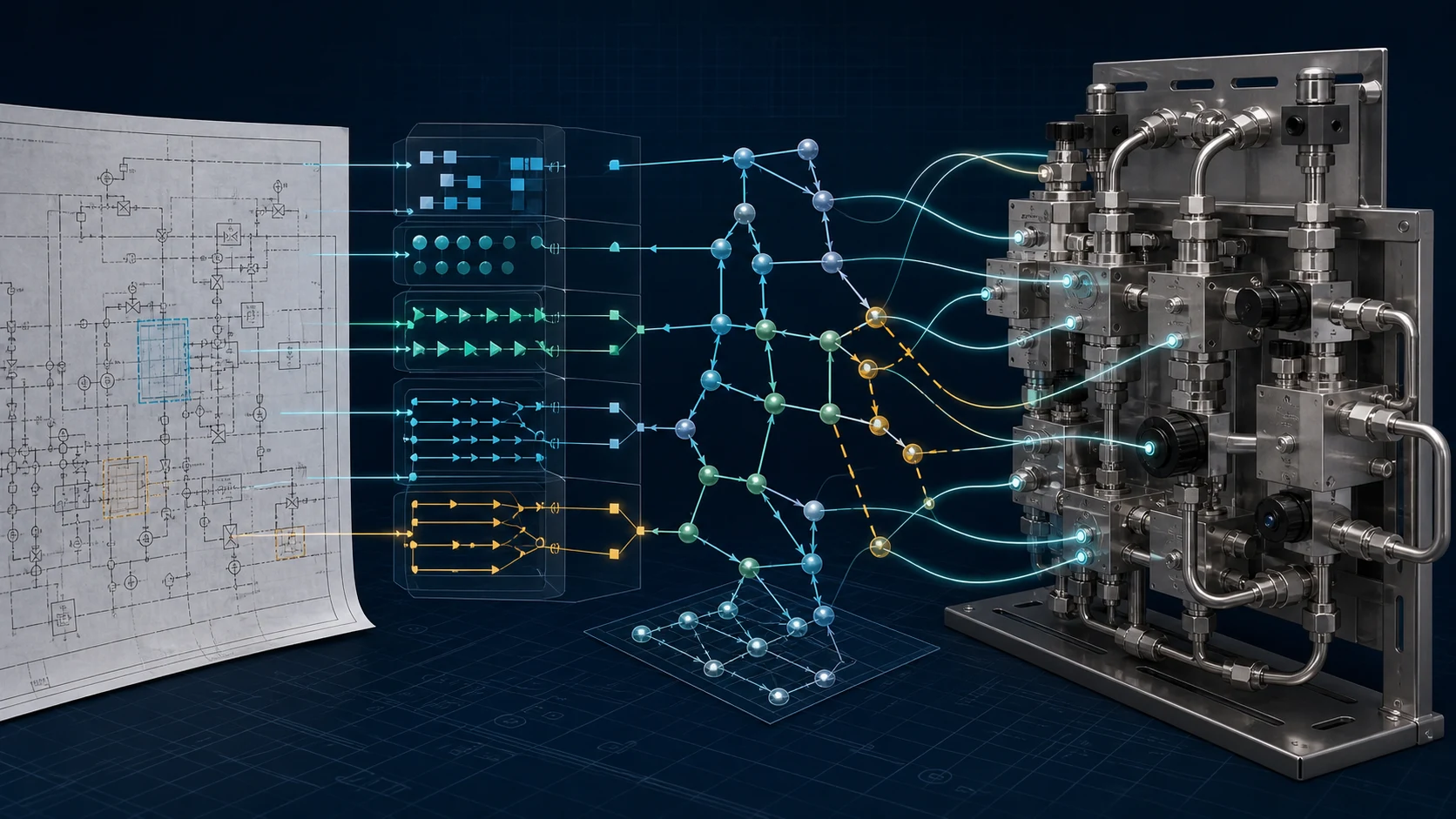
The useful commercial question is whether a bounded P&ID package can be converted into an auditable engineering model without silently inventing missing facts. The first deliverable should be a formalization package: source observations, resolved identities, directed/conditional edges, unresolved items and an obligation list that can later drive physical design.
That is different from commissioning an autonomous whole-machine design. It gives the customer a falsifiable first step and exposes data problems before they become expensive 3D layout or assembly rework.
Four readiness layers
1. Document identity
Freeze the file, revision, sheet set, issue purpose and checksum. A markup, superseded issue or missing continuation sheet can change topology even when most pixels look identical. The pilot must name who decides which revision is authoritative.
2. Visual and convention evidence
Collect legends, tag rules, line-style conventions, continuation rules and representative exceptions. ISO 10628-1 addresses the classification, content and representation of process diagrams, and ISO 10628-2 defines graphical symbols for chemical and petrochemical diagrams. Those standards support a shared vocabulary; they do not eliminate company- and project-specific drafting practices.
3. Engineering scope
Declare the in-scope equipment, lines, instruments, branches and operating conditions. A pilot may intentionally exclude utility systems, electrical diagrams or handwritten change regions. Exclusions are not failure if they are visible before work begins.
4. Acceptance and authority
Name the engineer who can approve tag identity, flow direction, connectivity and conditional state. Define what produces PASS, human review, FAIL_CLOSED or CANNOT_VERIFY. If no one can approve the formalized graph, the customer is not ready to use it as a design input.
What the pilot should return
- an inventory of pages, regions, symbols, tags, lines and continuations with source coordinates;
- a typed node and edge set with direction, condition and identity status;
- an exception queue grouped by missing evidence, conflicting evidence and unsupported convention;
- coverage and error metrics against a customer-reviewed gold subset;
- a design-obligation export showing which graph edges are ready for physical realization;
- a versioned evidence record so the result can be reproduced after a drawing revision.
Do not accept OCR accuracy as the business result
A high text-recognition score can coexist with a wrong process graph. One missed line crossing, reversed direction cue or incorrectly merged tag can matter more than hundreds of correctly transcribed characters. Commercial acceptance should therefore measure tag binding, edge correctness, direction, conditional state, evidence localization and false-pass severity.
When to postpone the pilot
Postpone when the customer cannot identify the current drawing, the sheet package is incomplete, no legend or knowledgeable reviewer is available, or success is defined only as “looks right.” First repair the document contract. Starting with unresolved authority creates a demo that neither side can objectively accept.
Decision
If one bounded P&ID package has an owner, a frozen revision, known conventions and a reviewable obligation set, it is ready for a controlled pilot. Request a live technical challenge with non-confidential scope information, or review the full P&ID-to-SolidWorks pilot contract.
References
- ISO 10628-1:2014 — classification, content and representation of flow diagrams. Accessed 2026-08-07.
- ISO 10628-2:2012 — graphical symbols. Accessed 2026-08-07.
- IEC 62424:2016 — process-control requests in P&IDs and engineering-tool data exchange. Accessed 2026-08-07.
Limit: this article defines input readiness and acceptance. It does not claim that MST can automatically parse every customer PDF or every project convention.
MST Engineering Intelligence. “Is Your P&ID PDF Ready for an Engineering-AI Pilot?.” MST Engineering Intelligence. Updated 2026-08-08. https://mst-us.ai/qualify-pid-pdf-engineering-ai-pilot/
CUSTOMERS · PARTNERS · INVESTORS
Talk to the engineering team.
Bring a non-confidential P&ID question, pilot boundary or technical diligence request. Protected engineering material is exchanged only after identity, NDA and scope review.
Operated by MOORE SOLUTION TECHNOLOGY PTE. LTD. · Singapore UEN 202315239E