
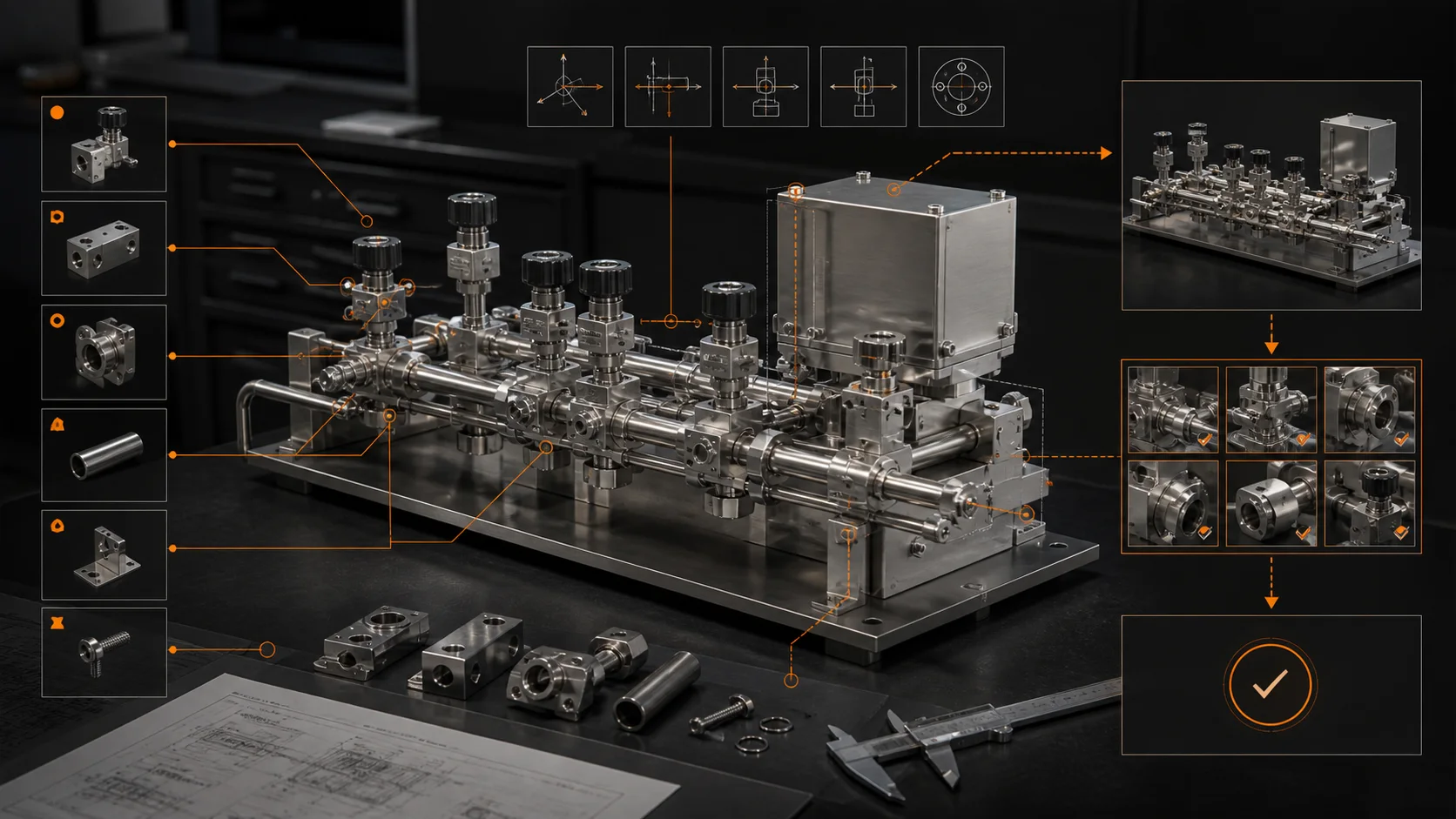
Direct answer: the investment wedge is a closed engineering compiler that starts before CAD and ends after CAD. It must preserve P&ID intent, bind enterprise part truth, solve a physical 3D implementation, execute a native SolidWorks assembly and reverse-prove the result. Native-CAD reading by itself does not close that loop.
Why the entry point is narrow
Industrial AI markets are broad, but a broad first claim is difficult to validate. Semiconductor process-equipment modules offer a focused starting domain: process intent is represented in P&IDs, component identity matters, physical routing has concrete BOM consequences and SolidWorks assemblies can be interrogated after execution.
The first product scope can therefore be falsifiable. Either identified input obligations are realized in the native assembly with evidence, or they are not. That is more investable than an open-ended claim to “assist every engineer.”
The connected barriers
- Document semantics: PDFs contain symbols, tags, linework, continuations, revisions and project conventions.
- Directed topology: process meaning depends on direction, state and conditional connectivity.
- Enterprise identity: BOM, SAP/PDM records and approved model revisions must refer to the same part.
- Interface truth: ports, axes, sealing faces and orientation must be derived from real geometry evidence.
- 3D physical solving: discrete selection and continuous pose/routing decisions interact with boundaries and BOM.
- Native execution: components and mates must exist in an editable SolidWorks assembly.
- Reverse verification: the system must map the realized artifact back to every declared obligation.
A competitor can reproduce a landing-page claim quickly. Reproducing all seven layers, their data contracts and their failure behavior is a different undertaking.
Where compounding advantage can form
Approved historical assemblies can produce customer-specific priors: which part and interface candidates are normally valid, which layouts are accepted, where human reviewers intervene and which failure modes recur. This is valuable only when observations retain provenance and approvals. Uncontrolled learning from customer designs could instead create IP, security and correctness risk.
The compounding asset is therefore not a generic prompt history. It is a governed engineering memory connected to source identity, deterministic rules, execution facts, verdicts and customer boundaries.
The architecture for expansion
Assembly IR separates a physical solution from vendor-specific CAD operations. Components, interfaces, connections, poses, mates, routes and evidence obligations are represented before calling SolidWorks. This creates an architectural route to additional adapters, but an adapter is not automatically a product. Every new CAD system and equipment domain needs its own execution oracle, engineering rules, negative tests and deployment evidence.
Investor diligence questions
- Does a fresh run create a new native
.sldasm, or replay an old result? - Can the system reopen the artifact and extract realized mates and component identities?
- Can an engineer trace one P&ID edge to a physical path and CAD faces?
- What happens when identity, geometry or rules are ambiguous?
- Which results come from controlled fixtures, and which come from a real deployment?
- Who owns customer models, derived evidence and learned priors?
- Which metrics are measured, and which efficiency claims are still hypotheses?
Evidence before market-size narrative
The correct next proof is not a larger adjective. It is a continuous, fresh, reviewable run plus a controlled customer pilot with frozen acceptance criteria. Market expansion should follow evidence: first additional module classes, then broader equipment families, then additional CAD adapters or industries where the same compiler contract remains valid.
References
- SOLIDWORKS API 2026 — IAssemblyDoc assembly operations.
- W3C PROV-DM — entities, activities, agents and derivations.
- NIST AI RMF 1.0 — use-case-specific AI risk management.
Limit: this is a strategic investment thesis, not a financial forecast, valuation, customer endorsement or statement that broader markets have already been won.
MST Engineering Intelligence. “The Industrial AI Investment Wedge: Native SolidWorks Plus Reverse Proof.” MST Engineering Intelligence. Updated 2026-08-08. https://mst-us.ai/industrial-ai-investment-wedge-native-solidworks/
CUSTOMERS · PARTNERS · INVESTORS
Talk to the engineering team.
Bring a non-confidential P&ID question, pilot boundary or technical diligence request. Protected engineering material is exchanged only after identity, NDA and scope review.
Operated by MOORE SOLUTION TECHNOLOGY PTE. LTD. · Singapore UEN 202315239E