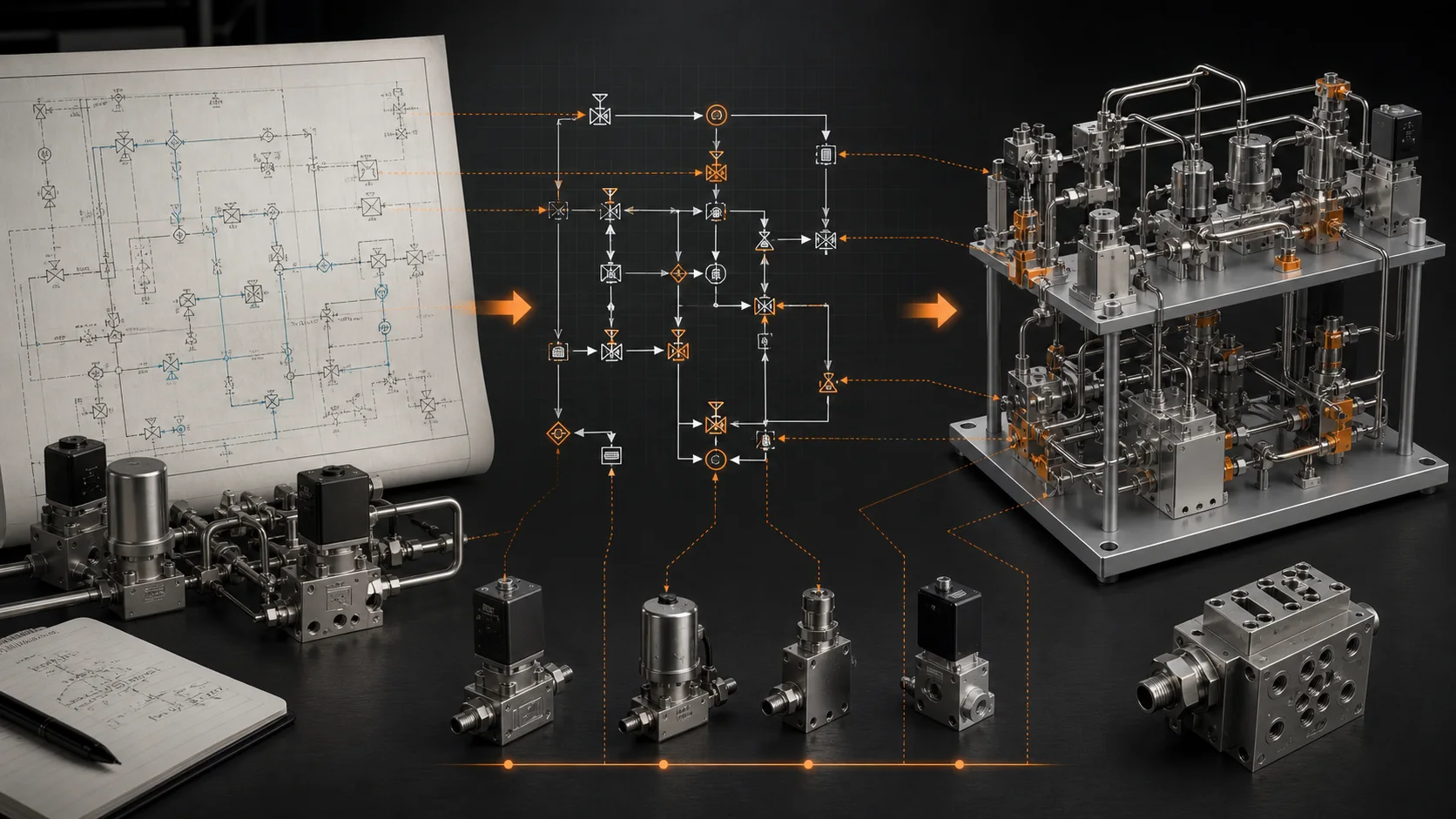
Direct answer: an equipment maker is ready for a P&ID-to-SolidWorks pilot when it can provide one bounded module, one controlled P&ID package, an approved BOM/component library, explicit engineering rules and a named human release authority. A pilot should not begin with a promise of autonomous whole-machine design.
The qualification test
A credible first pilot is not selected because the drawing looks impressive. It is selected because the input identity and expected result can be frozen. The commercial question is therefore not “Can AI design our equipment?” It is “Can this system close a defined set of engineering obligations using our approved parts and prove the result?”
The minimum input package should identify the P&ID revision, BOM revision, permitted component models, physical envelope, routing rules, prohibited regions, connection requirements and the SolidWorks version used for execution. Each input needs an owner. If two teams disagree about which BOM or rule is authoritative, that disagreement is part of the pilot scope—not something an AI system should silently resolve.
Why the P&ID cannot be treated as a picture
ISO 10628-1 covers the classification, content and representation of flow diagrams, while ISO 10628-2 defines graphical symbols for chemical and petrochemical diagrams. IEC 62424 addresses representation of process-control engineering requests in P&IDs and exchange between P&ID and PCE engineering tools. These standards do not prove that any particular PDF is machine-readable. They show why the document carries engineering semantics beyond text recognition.
A pilot should therefore test whether the system preserves tag identity, connectivity, direction, conditional state, cross-page continuation and the source location from which each observation was derived. OCR accuracy alone is not the acceptance criterion.
Define the deliverable before the demo
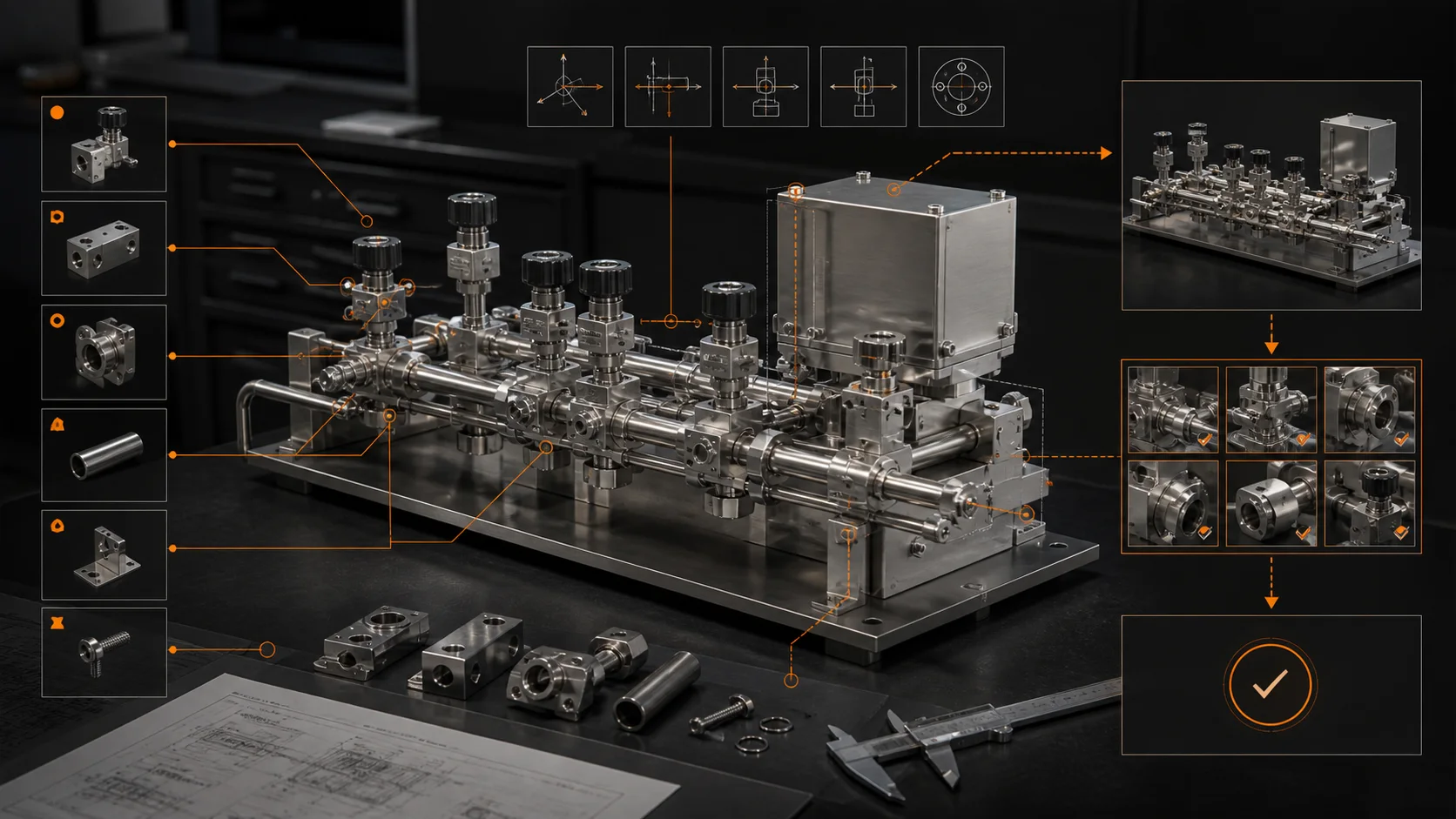
- Native artifact: a new, editable SolidWorks assembly using approved customer component models.
- Realized facts: component identities, poses, mates, rebuild result and interface facts extracted after reopening the assembly.
- Traceability: each in-scope P&ID edge maps to a physical path and to the relevant SolidWorks facts.
- Failure behavior: missing part identity, ambiguous interface evidence or unsatisfied constraints produce review or fail-closed outcomes.
- Human authority: an engineer accepts, rejects or changes the output before any production release.
Good and bad first scopes
A good scope is a modular gas stick, panel or box with a controlled component library and observable connection obligations. It has enough variety to expose the real engineering problem but is small enough for every decision to be reviewed.
A bad scope is “design any machine from any PDF.” It hides disagreements about requirements, part masters, interface truth, layout authority and release responsibility inside one impossible success metric. It also makes failure analysis useless because no one can identify which obligation was violated.
What MST currently claims
MST’s declared product scope begins with P&ID PDFs and approved engineering inputs, reasons over directed/conditional intent, binds existing qualified component models, solves a controlled continuous 3D physical implementation, compiles SolidWorks assembly instructions and returns evidence with an explicit verdict. The current public scope does not claim arbitrary whole-machine autonomy, universal dirty-CAD understanding or production release without engineer approval.
Decision checklist
Proceed when the customer can answer yes to five questions: Is the module bounded? Are the authoritative inputs identified? Are approved component models available? Can success and refusal be tested? Is a qualified engineer accountable for release? If any answer is no, first fix the engineering data contract.
References
- ISO 10628-1:2014 — specification of flow diagrams.
- ISO 10628-2:2012 — graphical symbols.
- IEC 62424:2016 — P&ID/PCE representation and data exchange.
Limit: this guide defines a qualification and acceptance model. It does not assert suitability for a specific customer dataset without a controlled technical review.
MST Engineering Intelligence. “When Should an Equipment Maker Run a P&ID-to-SolidWorks Pilot?.” MST Engineering Intelligence. Updated 2026-08-08. https://mst-us.ai/when-to-run-pid-to-solidworks-pilot/
CUSTOMERS · PARTNERS · INVESTORS
Talk to the engineering team.
Bring a non-confidential P&ID question, pilot boundary or technical diligence request. Protected engineering material is exchanged only after identity, NDA and scope review.
Operated by MOORE SOLUTION TECHNOLOGY PTE. LTD. · Singapore UEN 202315239E